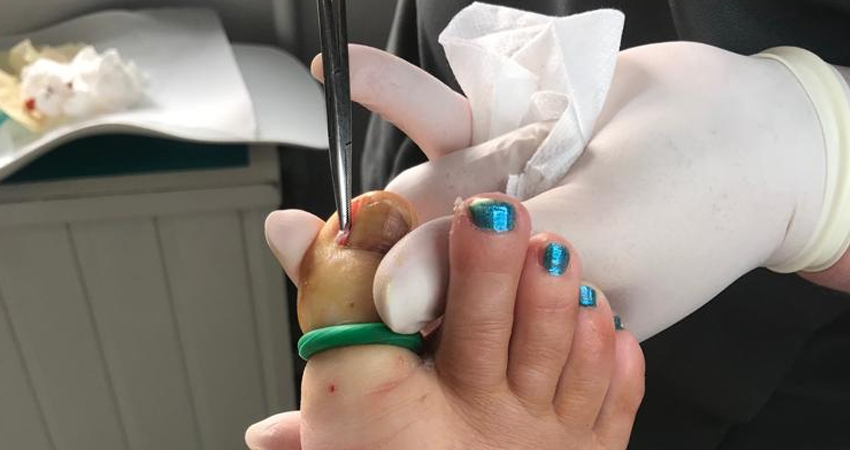
Nail Removal – Skin & Soft Tissue Procedures
Nail conditions — particularly ingrown toenails and nail infections — are among the most common reasons patients seek surgical care. When conservative measures fail to resolve nail pathology, surgical nail removal (avulsion) or permanent nail ablation offers definitive treatment with excellent outcomes. Dr. Pravin Goykar performs nail surgery under local anaesthesia as a straightforward day-care procedure, offering rapid relief and lasting resolution.
Conditions Requiring Nail Removal
Ingrown Toenail (Onychocryptosis)
An ingrown toenail occurs when the nail edge grows into the surrounding skin, causing pain, redness, swelling, and infection. It most commonly affects the great (big) toe. Surgical treatment is indicated when conservative management (warm soaks, proper nail trimming, antiseptics) has failed, or when there is significant infection, granulation tissue, or recurrence.
- Partial nail avulsion with phenolisation (PNA + phenol) – removal of the offending nail edge and chemical ablation of the nail matrix to prevent regrowth of that edge
- Total nail avulsion – complete removal of the nail plate for severe or recurrent cases
- Nail bed wedge resection – surgical removal of the nail edge and a portion of the nail bed
- Zadik procedure – permanent removal of the entire nail and nail matrix for recurrent bilateral ingrown nails
Subungual Haematoma
A collection of blood beneath the nail plate following trauma. When large and causing significant pain, the nail may need to be partially or fully removed to drain the haematoma and allow healing of the nail bed.
Paronychia (Nail Fold Infection)
Acute bacterial infection of the nail fold (periungual tissue) causing pain, swelling, and pus accumulation. Surgical drainage — sometimes including partial nail removal to decompress the nail fold — provides immediate relief and eradicates the infection.
- Incision and drainage of acute paronychia
- Partial nail avulsion if pus tracks beneath the nail plate
Onychomycosis (Fungal Nail Infection)
Severe or treatment-resistant fungal infections of the nail may require surgical nail removal to allow topical antifungal therapy to reach the nail bed and nail matrix directly, improving cure rates alongside systemic antifungal treatment.
Subungual Tumours & Lesions
- Glomus Tumour – A benign but intensely painful vascular tumour beneath the nail, requiring nail removal and precise excision.
- Subungual Exostosis – A bony outgrowth beneath the nail causing nail deformity and pain, managed surgically.
- Subungual Melanoma – Suspicious pigmented lesions beneath the nail requiring biopsy or excision to exclude malignancy.
- Pyogenic Granuloma – Benign vascular lesions at the nail fold or beneath the nail, treated with excision.
Nail Dystrophy & Deformity
Severe nail deformities causing chronic pain or functional impairment that do not respond to conservative treatment may require partial or total nail ablation for lasting relief.
Surgical Techniques
- Partial Nail Avulsion (PNA) – Removal of only the affected nail edge, preserving the central nail plate.
- Total Nail Avulsion (TNA) – Complete removal of the entire nail plate.
- Chemical Matrixectomy (Phenolisation) – Application of phenol to the nail matrix after avulsion to permanently prevent regrowth of the treated edge.
- Surgical Matrixectomy – Surgical excision of the nail matrix for permanent removal, preferred when chemical matrixectomy is contraindicated.
- Winograd Procedure – A wedge resection technique removing the lateral nail, matrix, and nail fold to correct recurrent ingrown nails.
Procedure & Recovery
- Performed under local ring block anaesthesia — virtually painless during the procedure
- Day-care procedure with no hospital admission required
- Digital tourniquet applied for a bloodless operative field
- Sterile dressing applied post-procedure
- Weight-bearing allowed with appropriate footwear on the same day
- Wound reviewed at 48–72 hours and dressings changed as needed
- Complete nail regrowth (where preserved) takes 6–12 months
Why Choose Dr. Pravin Goykar?
- Precise surgical technique minimising recurrence of ingrown nails
- Appropriate technique selection — partial vs. total avulsion, with or without matrixectomy
- Performed under local anaesthesia as a quick, comfortable day-care procedure
- Comprehensive post-operative wound care and dressing advice
- Histopathological examination of excised tissue when malignancy is suspected
- Patient guidance on nail care and footwear to prevent recurrence